

Our Strategic Initiatives
CRKN’s work is guided by three strategic goals from our Strategic Plan 2025–2029: Drive the Evolution of Open Knowledge, Share our Collective Value, and Innovate and Collaborate for a Sustainable Future. We continue to make significant progress towards these goals, and this section describes the work that happened this year to support and contribute to each of them.


Drive the Evolution of Open Knowledge
The research landscape is rapidly changing. Working with our members as a collective community, we must actively drive these changes to create an open and sustainable research ecosystem that can truly advance equitable access to knowledge.
License Renewals
With guidance from our Content Strategy Committee (CSC), CRKN renewed 10 content licenses as well as our membership agreement with Center for Research Libraries in 2025–2026. As part of these renewals, the JSTOR and ARTstor agreements were combined into one license to streamline invoicing for our members, and we extended our open access pilot agreement with Canadian Science Publishing for two more years. These renewals are part of how we provide CRKN members and the communities they serve with equitable, sustainable access to global knowledge through negotiations with publishers focused on cost-savings and best-practices in licensing.
Building Support for the 2026 License Negotiations
As CRKN prepared for the renewal of agreements with five major scholarly publishers, leaders from across Canada’s research ecosystem came together to support CRKN’s 2026 negotiations. In early 2026, CRKN formed a new Stakeholder Alignment Group, with senior leaders representing universities, research funders, and national organizations publicly supporting CRKN’s negotiation efforts. Their support showcases the growing recognition that the challenges facing scholarly communications extend beyond libraries and require a coordinated, sector-wide response. This broad support strengthens CRKN’s efforts to advance equitable and sustainable outcomes for Canada’s research community.
Expanding and Diversifying Canadiana
Over the past year, CRKN completed five projects from member institutions as part of our pilot call for Canadiana Collection Development Projects. These projects expand the Canadiana Collection to fill gaps in the digital historical record and serve research needs. We also added 250 issues of The Dawn of Tomorrow, a landmark newspaper that served the Black Canadian community for nearly 50 years, and the entire run of The Chinese Times, the longest-running newspaper in Canada’s largest Chinese community. These significant collections enhance Canadiana with content by and for underrepresented communities and were among the most highly consulted titles in Canadiana in 2025.


Completion of the Canadiana Development Roadmap
The Canadiana Development Roadmap, launched in 2024, set out a coordinated plan to modernize Canadiana’s underlying infrastructure and improve access to Canada’s digital heritage collections. In 2025, CRKN completed the full set of roadmap milestones through close collaboration across internal teams, member institutions, and external partners. This work delivered significant enhancements to the platform, including improved search functionality, expanded API access, and a more accessible and user-centered image viewer. The completion of the roadmap marks a key step forward in the evolution of Canadiana and establishes a strong foundation for continued development of Canadiana 2.0 and future improvements to Canada’s national digital collections infrastructure.
Canadiana User Engagement and Research
In 2025, CRKN shared the results of its most significant user engagement initiative for Canadiana in several years, providing valuable insight into how researchers, educators, genealogists, members of the public, and GLAM professionals use the platform. The Canadiana User Survey Report presented findings from more than 13,000 survey responses collected across the platform, highlighting strong engagement from users across Canada and beyond, with history, genealogy, and Indigenous studies emerging as key areas of interest. Building on these findings, CRKN also conducted a series of in-depth user interviews to gain a deeper understanding of user experiences and needs. Together, the survey results and interview findings are helping to guide future platform enhancements in the ongoing development of Canadiana.
Growing the ORCID Canada Consortium
This year, the Canadian PID community continued to grow significantly. Thanks to ORCID-CA renewals and new member recruitment, the consortium has reached the milestone of 60+ members, the highest membership tier, securing lower fees for all members next fiscal. Growth was particularly strong in Quebec, where six institutions joined: INRS, UQO, UQTR, UQAC, TELUQ, and Polytechnique Montréal. The team also strengthened international collaboration through ORCID Consortium Lead Workshops in South Africa and Vancouver, and the number of connected ORCID iDs increased year over year.
Strengthening the DataCite Canada Consortium
This year marked the 5th anniversary of the DataCite Canada Consortium – a collaboration between CRKN and the Digital Research Alliance of Canada. The PID Program strengthened its international impact thanks to the election of John Aspler, Manager of the Canadian PID Program, to the DataCite Board. DataCite Canada recruited 12 new members and registered 64,764 DOIs. Additionally, CRKN itself has joined DataCite Canada and began registering DOIs for reports and blog posts, bringing our practices into closer alignment with its own programs.

Share our Collective Value
The Canadian library community is strong and determined to build a better future for researchers and the public. We have bold goals and to reach them we will need to advocate effectively for our vision by making our value and impact clear to the research community and beyond.
2025 CRKN Member Summit and AGM
More than 150 CRKN members and invited guests gathered in Halifax, Nova Scotia, for the 2025 Member Summit and Annual General Meeting. Through facilitated discussions and collaborative sessions, participants explored strategic priorities including the future of Canadiana, the implementation of a national persistent identifier strategy, the expansion of the Scholars Portal Journals Platform, and preparations for upcoming license negotiations. New director-focused discussions created dedicated opportunities for library leaders to engage on long-term sustainability and policy issues. The event concluded with CRKN’s Annual General Meeting, where members reflected on the year’s achievements and helped shape the organization’s future direction.


Launching Knowledge Exchange
This year, CRKN launched Knowledge Exchange, a new blog dedicated to sharing insights and stories from CRKN and across the Canadian scholarly and library communities. During its first year, the blog featured 12 posts from CRKN staff and guest contributors at member institutions, highlighting topics ranging from local digitization initiatives and digital heritage projects to emerging developments in research infrastructure. Through Knowledge Exchange, CRKN has created a new platform to share CRKN’s projects, staff expertise, and topics of interest to members. The blog also provides a space to highlight innovative work taking place across our network and foster connections among members and partners.
The 2025 CRKN Virtual Conference
The 2025 CRKN Virtual Conference brought together researchers, librarians, publishers, and digital heritage professionals from across Canada to explore the theme Open Knowledges and Sustainable Futures. Through presentations and panel discussions, participants examined how open scholarship, digital infrastructure, and collaboration can support a more equitable and sustainable research ecosystem. The conference showcased innovative projects and emerging trends in scholarly communication, open access publishing, research infrastructure, and data stewardship, providing valuable opportunities for knowledge sharing and professional connection. Once again, the strong engagement and high-quality contributions from presenters demonstrated the vitality and collaborative spirit of Canada’s research community.
Expanding the Canadian PID Community’s Reach
The Canadian PID team strengthened its community engagement this past year, by connecting with CPIDAC members during an in-person meeting, sharing knowledge with the broader PID community nationally and internationally through 16 presentations and webinars, and relaunching the ORCID-CA Community Call series as a space for members to learn from one another and connect with the community.

Innovate and Collaborate for a Sustainable Future
As we create pathways to trusted knowledge, we will work together inclusively and creatively to build the empowered future that we believe in – and it must be a future that is sustainable for our member institutions.
Securing Major Investment in Canadiana’s Future
After years of development, CRKN’s Open Science Infrastructure for Canad(ian)a: Digital Collections of the Future application to the Canada Foundation for Innovation’s (CFI) Innovation Fund was successful. Led by the University of Ottawa in partnership with institutions across Canada, this project has been awarded more than $4 million from CFI to support the transformation of Canadiana’s digital research infrastructure. The project will enhance access to millions of pages of historical and cultural materials, enabling new forms of computational and AI-driven research while improving usability for researchers, students, educators, and the public. The grant reflects the collective efforts of CRKN members and partners to transform Canadiana into critical national research infrastructure.
Advancing Open Access Policy in Canada
As the Tri-Agency reviewed its Open Access Policy on Publications, CRKN brought together feedback from member institutions across the country to help inform the next phase of open scholarship in Canada. Drawing on the expertise of the academic library community, CRKN advocated for a policy framework that supports sustainable open access, protects author rights, strengthens research discoverability, and recognizes the critical role of library-managed infrastructure. CRKN also emphasized the importance of persistent identifiers, interoperability, and compliance mechanisms to ensure the long-term effectiveness of the policy. This contribution helped ensure that the perspectives of Canada’s academic libraries were represented in a national conversation about the future of research access and open science.
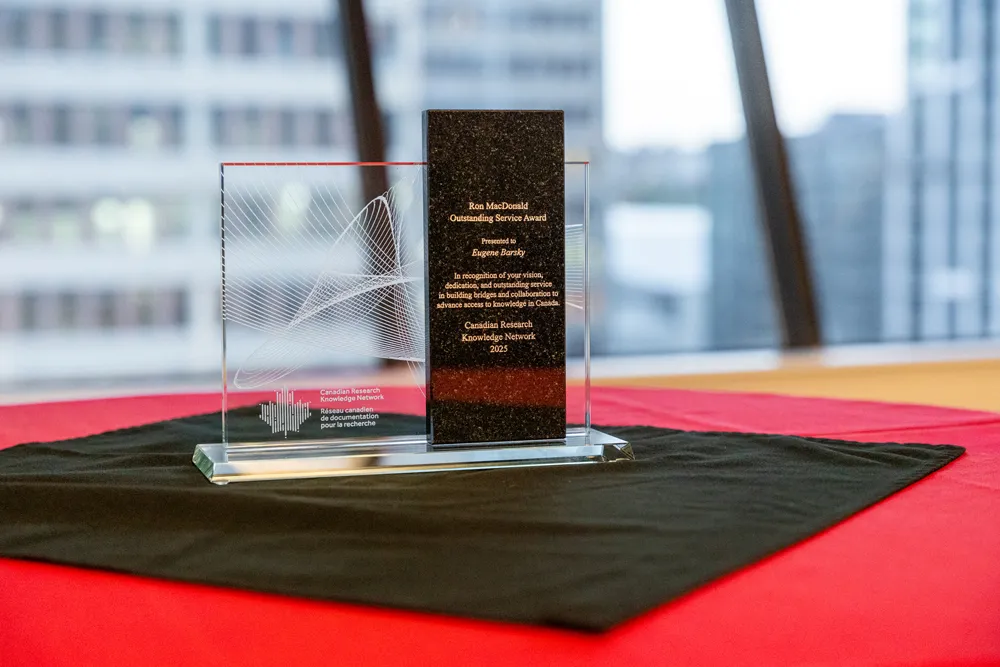
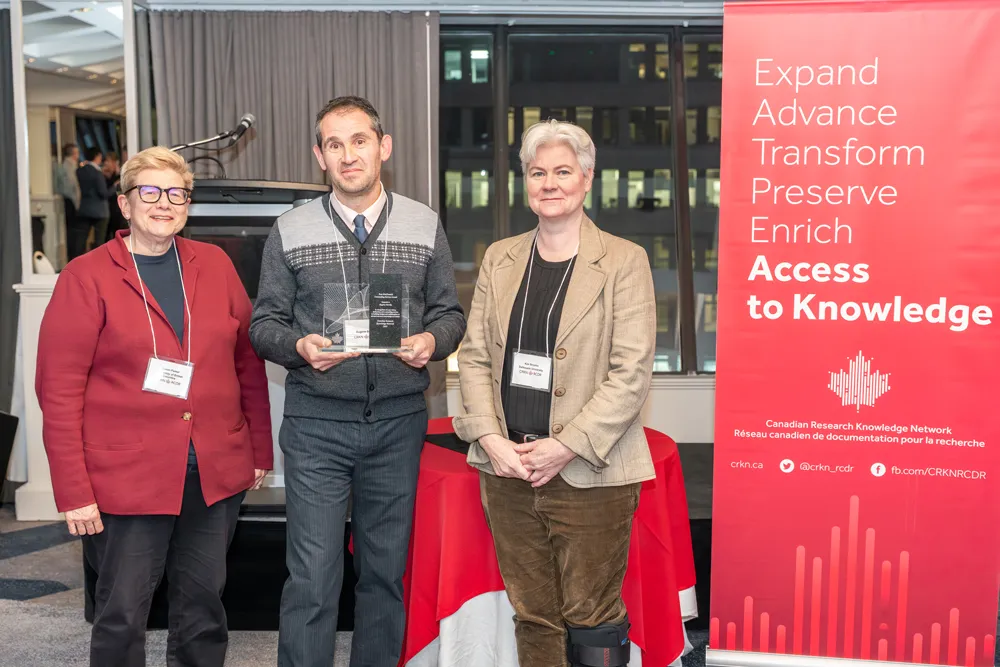
Eugene Barsky Awarded the Ron MacDonald Outstanding Service Award
The Ron MacDonald Outstanding Service Award recognizes an individual from a CRKN member institution who has demonstrated vision, dedication, and outstanding service in advancing knowledge infrastructure through collaboration and community building. This year’s recipient, Eugene Barsky, Research Data Management Librarian at the University of British Columbia, was honoured for his transformative leadership in Canada’s research data and persistent identifier (PID) ecosystem. Through his work to strengthen national DOI services, establish and expand the DataCite Canada Consortium, and advance research data management practices, Eugene has played a pivotal role in improving the discoverability, accessibility, and global interoperability of Canadian research. His contributions have helped position Canada as a leader in open and connected scholarly infrastructure while inspiring future generations of information professionals.

Completion of the RG10 Pilot Project
Last year, we successfully completed our pilot project to transcribe two million pages of handwritten content in the Héritage Collection in partnership with Library and Archives Canada (LAC). Focused on a sub-collection of the RG10 fonds, “Records relating to Indian Affairs,” this pilot project transcribed over 1,500 digitized microfilm reels with the intelligent character recognition (ICR) tool Transkribus. This impactful project not only provided full-text search capability and downloadable PDFs for dozens of collections relied upon by Indigenous land claims researchers and historians, but also allowed CRKN to explore ICR as a method of improving the accessibility of the Canadiana Collections and Infrastructure.
Investigating Next-Generation OCR Technologies
To improve the discoverability of Canadiana’s collections, CRKN evaluated emerging open-source optical character recognition (OCR) technologies as part of our infrastructure development work. Using the Chinese Times collection as a test case, staff compared the performance of the open-source Paddle OCR platform with existing commercial software. The assessment highlighted the potential of AI-powered OCR tools to improve text recognition, layout analysis, and support for multilingual collections, while providing valuable insights to guide future OCR and handwritten text recognition workflows for the Canadiana and Héritage collections.
Collaborating on PIDs for Funders to Support Canadian Researchers
A specific area of focus for collaboration this year has been around PIDs for Funders. Important funders joined Crossref (FRQ) and DataCite (CFI), both of which enable the registration of DOIs for Grants and Awards. FRQ is now the second largest minter of DOIs for grants in the world, having registered roughly 25,000 DOIs dating back to 2019. This year, CFI and the Canadian Cancer Society (CCS) joined 3 other funders – FRQ, NSERC, and SSHRC – as members of ORCID-CA, highlighting the importance for and value of funders connecting ORCID to their grant application platforms. NSERC and SSHRC launched an ORCID integration in Convergence, which became the number one connected system in Canada with over 8,400 ORCID iDs connected to the platform. FRQNet similarly launched an ORCID integration in FRQNet, the second most connected platform with 3,600 connected ORCID iDs and 60 ORCID Records receiving grant and peer review metadata updates. CFI and the Canadian Cancer Society worked to actively develop their own ORCID integrations as well. These DOIs and ORCID integrations will significantly reduce the administrative burden on scholars when applying for funding.