
Collaboration in Action:
Building an open and equitable future, together.
Annual Report 2025–2026
For our member organizations and the diverse communities they serve, CRKN empowers researchers, educators, and society with greater access to the world’s research and Canada’s preserved documentary heritage, now and for future generations.
Vision
Knowledge is accessible to all.
Mission
Together, we empower Canada by creating pathways to trusted knowledge.
A message from the Executive Director
What an exciting year of achievement and collaboration for CRKN! Throughout 2025–2026, CRKN continued to advance its mission to empower Canada by creating pathways to trusted knowledge. Through the collective efforts of our members, Board, committees, task groups, and staff, we have strengthened national research infrastructure, expanded collaboration across the scholarly community, and built important foundations for future innovation. As I reflect on the accomplishments of the past year, I am proud to share the progress we have made together.
In an increasingly complex scholarly publishing environment, CRKN’s licensing team negotiated renewed agreements to ensure CRKN members have equitable, sustainable access to global knowledge while offering sustainable pathways to open access. In preparation for our 2026 negotiations with five of the largest scholarly publishers—Elsevier, Sage, Springer Nature, Taylor & Francis, and Wiley–CRKN staff conducted individual consultations with our members and undertook extensive data analysis. Through consultations, webinars, and ongoing engagement, members helped to shape our approach and ensure that collective priorities remain at the heart of this work. That same commitment to collective action was also reflected at our AGM, where members voted to expand the Scholars Portal Journals platform into a national shared service, laying the groundwork for what will become a critical piece of Canada’s national knowledge infrastructure. Together, we are working to address rising costs while advancing sustainable access to scholarly content and supporting a stronger, more connected research ecosystem.
After years of development, collaboration, and member support, I am so pleased to share that CRKN’s application to the Canada Foundation for Innovation’s Innovation Fund was successful! CFI has awarded more than $4 million to support the transformation of Canadiana’s digital research infrastructure. Led by the University of Ottawa in partnership with CRKN, the Digital Collections of the Future project brings together institutions and partners from across the country in a shared effort to strengthen Canada’s open science infrastructure. I am so grateful for the unwavering support of CRKN’s members in this project and our collective belief in how this project will reshape Canadiana’s collections into machine-actionable research data that will enrich our understanding of Canada’s past and help build a better future.
This spirit of collaboration extended across CRKN’s programs and partnerships throughout the year. In partnership with the Érudit Consortium, CRKN released an updated landscape analysis of the digital research infrastructure supporting humanities and social sciences research in Canada. At the same time, our Heritage Services and Infrastructure Development teams completed Canadiana’s current development roadmap and continued preparations for the next iteration of the Canadiana platform, informed by extensive consultation with researchers, librarians, and other users. Through a pilot call for Canadiana collection development projects, we were able to broaden representation within the digital heritage record in also expanded Canadiana’s collections.
Advancing interconnected, reliable research infrastructure remained a key priority this year, with our persistent identifier services continuing to expand their national reach. ORCID-CA and DataCite Canada welcomed new members from across the country, including increased participation from institutions in Quebec. Surpassing 60 consortium members in ORCID-CA reflects the growing importance of persistent identifiers in Canada’s research ecosystem and demonstrates the value of a collaborative national approach to research infrastructure.
From content licensing and research infrastructure to digital heritage collections and persistent identifiers, the achievements of this year demonstrate what is possible when organizations work together toward common goals. As we continue implementing our 2025–2029 Strategic Plan, CRKN remains focused on building sustainable infrastructure, advancing open knowledge, and delivering value to our members and the broader research community.
I would like to extend my sincere thanks to CRKN’s Board of Directors, committees, and task groups for their guidance and expertise throughout the year. My gratitude also goes to our staff, whose dedication, professionalism, and collaborative spirit continue to drive our work forward. Finally, I want to thank our members for their trust, engagement, and ongoing commitment to strengthening Canada’s research ecosystem. The progress highlighted throughout this report reflects the power of our collective efforts. Thank you for your continued partnership as we work together to strengthen the systems that support research, learning, and access across Canada.

Clare Appavoo
Executive Director, CRKN
A message from the Chair of the Board

Kim Brooks
Chair, CRKN Board of Directors
President and Vice-Chancellor, Dalhousie University
Building on over 25 years of collective progress, CRKN continued to demonstrate the power of collaboration in strengthening Canada’s research ecosystem in 2025–2026. In this first year of its new strategic plan, CRKN gathered momentum in its work to ensure that institutions, researchers, and communities have access to the trusted knowledge they need to learn, innovate, and thrive.
At its core, CRKN’s strategic value lies in its ability to bring institutions together to address shared challenges with coordinated, national solutions. In today’s landscape defined by financial pressure, rapid technological change, and evolving expectations for open scholarship, this collective approach has never been more essential. Through its licensing and open access, persistent identifiers, and digital heritage and infrastructure programs, CRKN is sustaining access to trusted knowledge while actively shaping a more equitable, resilient, and interconnected research environment for Canada.
In 2025–2026, CRKN engaged with its members to understand their needs and foster collaboration. This collective strength is critical as CRKN embarks on its 2026 licensing negotiations. CRKN’s 2026 licensing negotiations represent a pivotal opportunity to rebalance the scholarly communications system in Canada. Taking a coordinated approach to negotiating with the five largest commercial publishers—Elsevier, Sage, Springer Nature, Taylor & Francis, and Wiley—reflects both the scale of the challenge and the importance of collective action. At a time when rising costs, currency exchange rate pressures, and constrained institutional budgets are placing increasing strain on libraries and research institutions, these negotiations are about more than cost containment—they are about protecting access to knowledge, advancing sustainable publishing models, and reinforcing Canada’s long-term research competitiveness. As Chair of the Board, I am pleased to participate in the Stakeholder Alignment Group, which brings together leaders from across the research ecosystem to demonstrate broad, cross-sector support for CRKN’s approach. This alignment will be essential to ensuring that the outcomes of the 2026 negotiations reflect the shared priorities of institutions, researchers, and the broader public.
CRKN continues to strengthen Canada’s research infrastructure in ways that extend beyond scholarly content licensing with its heritage and persistent identifier programs, illustrating the deeply interconnected nature of its work across the Canadian research ecosystem. The recent investment from the Canada Foundation for Innovation in Canadiana underscores its significance as essential, library-led research infrastructure. As one of the largest openly accessible collections of digitized Canadian documentary heritage—comprising more than 69 million pages, spanning centuries—Canadiana enables data-driven, interdisciplinary research at a national scale. By supporting advanced computational methods, including machine learning and AI, and by upholding principles of data sovereignty and community stewardship, Canadiana will help researchers generate new insights into Canada’s past while addressing the complex challenges of our present and future.
At the same time, CRKN’s leadership in persistent identifiers (PIDs) is strengthening the digital infrastructure that underpins modern research. By advancing a national PID strategy and supporting their widespread adoption, CRKN is enabling reliable connections between researchers, their work, and their institutions, reducing administrative burden while enhancing transparency, attribution, and interoperability. In doing so, CRKN is advancing an integrated vision of a research ecosystem where knowledge is accessible, discoverable, and enduring.
As we move forward, I am continually reminded that CRKN’s greatest strength lies in its community. The progress we have made, and the impact we will continue to achieve, is the result of deep collaboration across our member institutions and partners. I would like to extend my sincere thanks to CRKN’s members for their ongoing engagement and support, to my fellow Board members for their leadership, and to the CRKN staff and volunteers whose dedication drives this work forward every day.
With strong collective support from member institutions across the nation, I am confident in CRKN’s ability to navigate the challenges ahead and continue advancing its mission of empowering Canada with access to trusted knowledge.
Our Members
CRKN supports 88 member institutions—including universities, libraries, and research institutions—with a shared commitment to advancing research, preservation and access, and open knowledge across Canada.
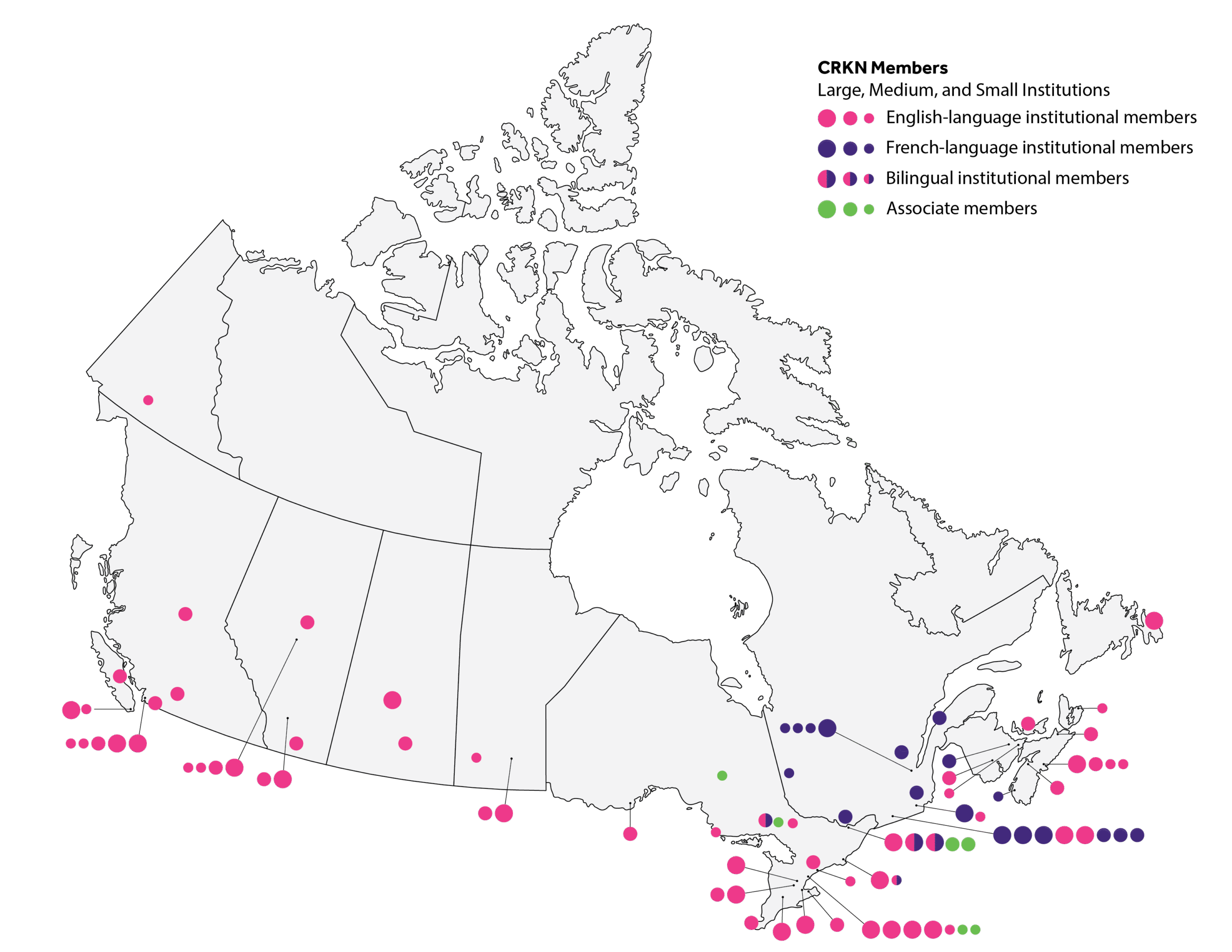
CRKN Members
British Columbia
Alberta
Saskatchewan
Ontario
Prince Edward Island
Nova Scotia
Newfoundland
Yukon
CRKN Associate Members